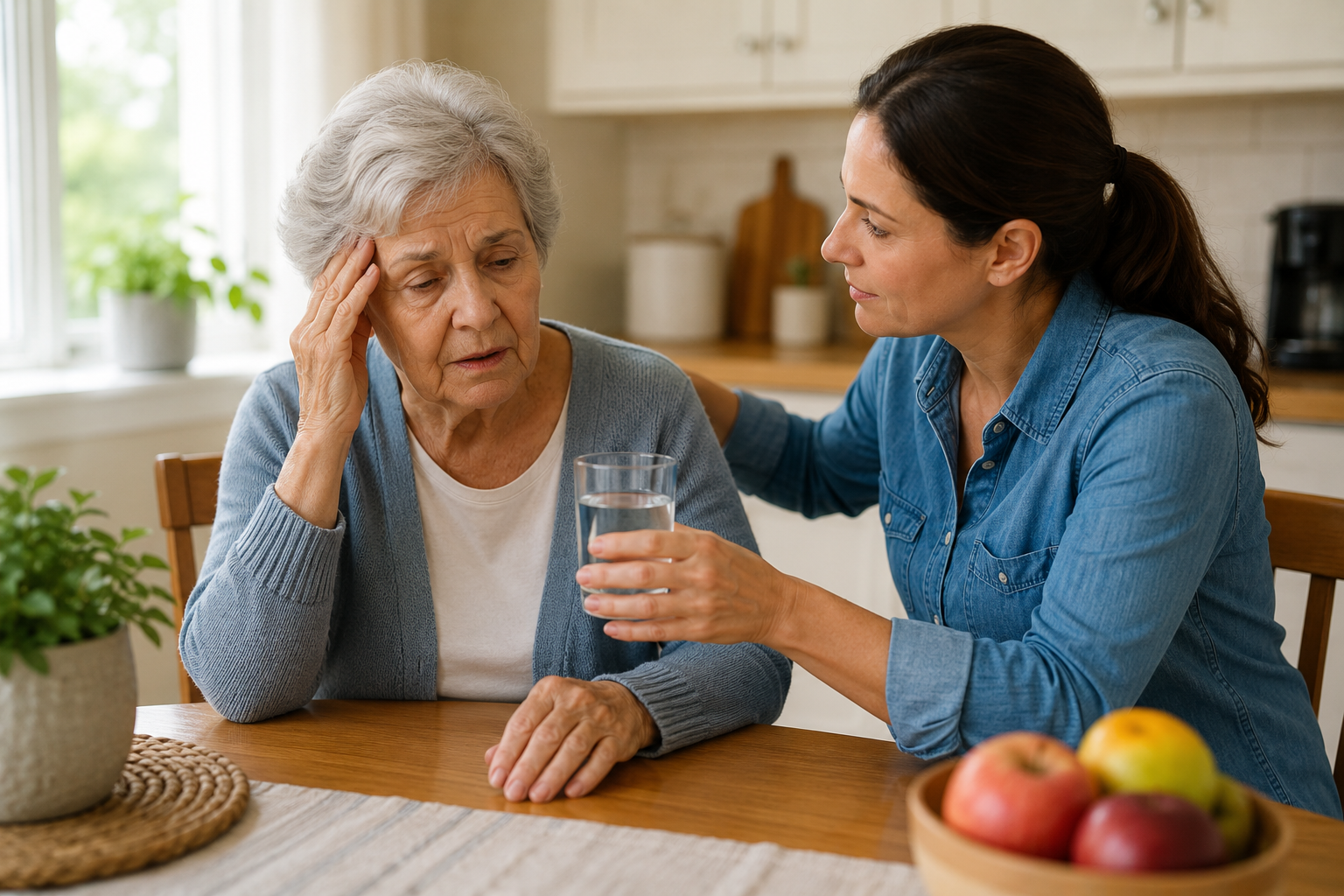
This is the first in a three-part series on dehydration in seniors. Part one covers why older adults are uniquely vulnerable and how to recognize the signs before they escalate. Parts two and three address the medical consequences and what caregivers can do to prevent a crisis.
All articles in this series:
I remember standing at a patient’s bedside during a night shift, reviewing her chart. She had been admitted for “altered mental status,” and her family was terrified they were watching the early stages of dementia unfold in real time. But something in her presentation did not add up. Her confusion had come on suddenly, not gradually. Her lips were cracked, her urine was dark amber, and she had not had a proper drink in nearly two days.
She was not losing her mind. She was severely dehydrated.
Within hours of IV fluids, she was lucid, laughing, and asking for her glasses so she could read. Her family could not believe the transformation. I have seen this scenario play out more times than I can count, and it never loses its impact. Dehydration in seniors is one of the most common, most dangerous, and most frequently overlooked health risks in older adults. This guide is for every caregiver who wants to understand why it happens, how to catch it early, and what to do before it becomes a crisis.
Why Are Seniors More Prone to Dehydration?
Dehydration in seniors is not simply a matter of not drinking enough water. It is a physiological reality built into the aging process itself, and understanding why helps caregivers stay one step ahead.
As we age, the body’s total water content decreases. A young adult’s body is roughly 60% water; by the time someone reaches their 70s or 80s, that figure can drop to around 45–50%. This means older adults have a significantly smaller fluid reserve to draw from when the body is under stress from heat, illness, or physical exertion.
Perhaps the most clinically significant factor is the blunting of the thirst mechanism. The hypothalamus, the part of the brain that triggers the sensation of thirst, becomes less sensitive with age. In practical terms, this means an elderly person can be meaningfully dehydrated and feel no urge to drink whatsoever. By the time they say “I’m thirsty,” the deficit is already significant.
Kidney function also declines with age. Healthy kidneys conserve water efficiently by concentrating urine when the body is low on fluids. Aging kidneys lose this ability, meaning seniors excrete more water than necessary even when they cannot afford to.
Add to this the medication burden many seniors carry. Diuretics, commonly prescribed for heart failure and high blood pressure, increase fluid loss by design. Laxatives, certain blood pressure medications, and even some antihistamines contribute to dehydration as a side effect. Many seniors are on four, five, or more of these medications simultaneously.
Nurse’s Note: Never assume your loved one is hydrated just because they are not complaining of thirst. In elderly patients, the absence of thirst is not reassurance, it is a known clinical blind spot. Build hydration into their routine rather than waiting for them to ask.
The Subtle Signs of Dehydration in Elderly Individuals
This is where dehydration becomes genuinely dangerous. Unlike a healthy young adult who might feel dizzy or get a headache when dehydrated, elderly patients often present with symptoms that are easy to attribute to something else entirely, aging, a bad night’s sleep, or an off day.
The result is that dehydration quietly deepens while everyone around the patient assumes nothing serious is happening.
In my years of clinical practice, the symptoms I have seen most frequently dismissed or misread include the following:
Sudden Confusion or Agitation: This is the one that catches families off guard the most. When an elderly person becomes unexpectedly confused, disoriented, or irritable, the instinct is often to attribute it to dementia or a neurological event. But sudden onset confusion, especially in a patient who was lucid the day before, is a classic sign of dehydration in seniors. The brain is extraordinarily sensitive to fluid balance, and even mild dehydration can impair cognitive function significantly in older adults.
Fatigue and Weakness: Feeling unusually tired or physically weak is easy to overlook in a senior, particularly one recovering from illness. However, when the body is low on fluids, blood volume drops, which means less oxygen and nutrients reach the muscles and organs. The result is a fatigue that feels heavier and more persistent than usual.
Dizziness and Increased Fall Risk: Dehydration lowers blood pressure. When an elderly person stands up from a seated or lying position, this drop becomes even more pronounced, a condition called orthostatic hypotension. The resulting dizziness lasts only a few seconds, but those seconds are when falls happen. Many falls that families attribute to general frailty are actually dehydration events in disguise.
Dry Mouth, Cracked Lips, and Sunken Eyes: These are the visible signs most people associate with dehydration, but in seniors they appear later in the process than in younger adults. Do not wait for these to show up before acting.
Dark or Reduced Urine Output: Urine color is one of the most reliable hydration indicators available to caregivers at home. Pale yellow is ideal. Anything darker than apple juice warrants attention. If your loved one is urinating very infrequently or not at all over several hours, that is a red flag requiring immediate action.
I recall a patient, let’s call her “Mrs. A,” whose daughter brought her in after three days of what the family described as “acting strange.” She was irritable, refusing meals, and sleeping far more than usual. The family had assumed she was depressed. Her labs told a different story, her sodium levels were critically elevated, a direct consequence of severe dehydration. She had simply stopped drinking after a mild stomach upset and nobody had tracked her fluid intake during those three days.
Nurse’s Note: Keep a simple hydration log on the refrigerator. Mark down every cup of fluid your loved one drinks throughout the day. You do not need a medical background to notice that your father only had half a cup of tea since yesterday morning. That observation alone could prevent a hospitalization.
About the author:
Becky Olamide is a Registered Nurse with clinical experience in PACU, pre-/post-op, and stepdown ICU, now specializing in academic writing, medical content development, curriculum design, and instructional design for healthcare and higher-education organizations. She is not an employee of B’zoe Care and does not provide care for its patients with medical services.