This is the final post in a three-part series on dehydration in seniors. Parts one and two covered why it happens, how to recognize it, and the medical consequences it triggers. This installment focuses on practical prevention, when to seek medical attention, and how professional support can fill the gaps.
All articles in this series:
Simple, Effective Ways to Prevent Dehydration at Home
Prevention is where caregivers have the most power. Unlike many health risks that require medical intervention, dehydration is largely manageable at home with the right systems and habits in place. The goal is to make adequate hydration the path of least resistance, something that happens consistently throughout the day without relying on thirst as the trigger.
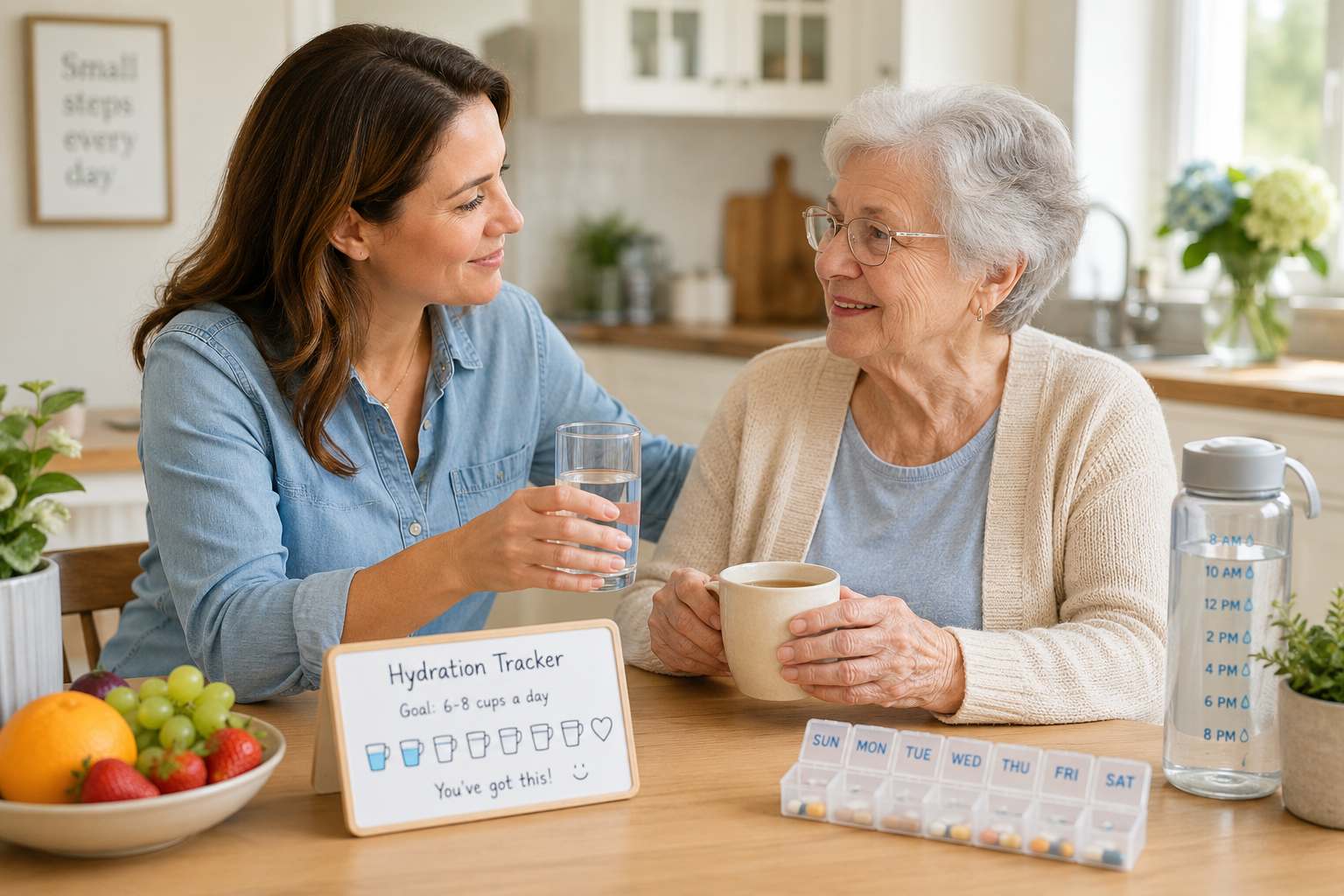
Build a Hydration Schedule, not a Habit: Habits require motivation and memory, both of which can be inconsistent. A schedule removes the guesswork entirely. Offer fluids at fixed, predictable times throughout the day, with morning medications, at every meal, mid-morning, mid-afternoon, and before bed. This approach ensures a baseline fluid intake regardless of whether your loved one feels thirsty, is having a good cognitive day, or is simply too tired to think about drinking.
Think Beyond Water: Many seniors resist plain water, particularly if they have never been big water drinkers. This is not an argument to give up, it is an invitation to get creative. Herbal teas, warm broths, diluted fruit juices, electrolyte drinks, and flavored water all count toward daily fluid intake. Foods with high water content, cucumbers, watermelon, oranges, soups, yogurt, and gelatin, are excellent supplementary sources of hydration, particularly for seniors who struggle with swallowing larger volumes of liquid.
Use Visual Cues and Reminders: Place a filled water bottle or cup within arm’s reach of wherever your loved one spends most of their time. Out of sight genuinely means out of mind for many elderly patients, particularly those with any degree of cognitive impairment. Consider using a marked water bottle that shows fluid levels throughout the day, or set gentle phone or watch reminders at regular intervals.
Monitor Output as Closely as Input: Tracking what goes in is only half the picture. Pay attention to urine frequency and color as well. A simple color chart, available free online and printable for the refrigerator, gives caregivers an immediate visual reference without requiring any medical knowledge. Aim for pale yellow. Anything darker signals a need for more fluids.
Adjust for High-Risk Situations: Certain conditions dramatically increase fluid loss and require proactive increases in intake. Hot weather, air conditioning that dries the air, fever, vomiting, diarrhea, and increased physical activity all deplete fluids faster than usual. During these periods, do not wait for symptoms to appear, increase fluid offerings immediately and monitor more closely than normal.
If your loved one has recently returned home from a hospital stay, dehydration risk is especially elevated during the recovery period. For a full guide on what families need to monitor closely in those critical first days at home, see our Complete Hospital Discharge Checklist for Elderly Patients.
Make It Social and Pleasant: For many seniors, the act of drinking is more likely to happen in a social context. A cup of tea shared during a conversation, a smoothie offered alongside a visit, or a favorite flavored drink served in a preferred cup can significantly increase voluntary fluid intake. The emotional context of hydration matters more than most caregivers realize.
- Offer small amounts frequently rather than large volumes infrequently, the stomach tolerates this better and reduces the risk of nausea.
- Keep beverages at the temperature your loved one prefers, some seniors drink significantly more when offered warm rather than cold fluids.
- Avoid excessive caffeine and alcohol, both of which have diuretic effects and contribute to fluid loss.
- If swallowing is a concern, consult a speech therapist about thickened liquids, which are easier and safer to manage.
Nurse’s Note: I always tell families: do not make hydration a negotiation. Frame it the same way you would a medication, non-optional, scheduled, and tracked. “Here is your afternoon tea” lands very differently than “Do you want something to drink?” One invites refusal. The other makes hydration the default.
When Should Caregivers Seek Medical Attention?
Knowing when to handle something at home versus when to pick up the phone, or call 911 is one of the most important skills a caregiver can develop. With dehydration specifically, the window between “manageable at home” and “requires emergency care” can close faster in elderly patients than most families expect.
When to Call the Doctor: Not every sign of dehydration requires an emergency room visit, but all of them require action. Contact your loved one’s physician promptly if you observe any of the following:
- Urine that has been dark or significantly reduced for more than 12 hours despite increased fluid offerings
- Mild confusion or unusual irritability that is new or out of character
- Fatigue or weakness that is noticeably worse than their baseline
- Complaints of dizziness, particularly when standing
- Reduced appetite combined with low fluid intake over 24 hours or more
- Nausea or vomiting that is preventing adequate fluid intake
Do not wait for multiple symptoms to stack up before calling. One persistent symptom in an elderly patient is enough to warrant a conversation with their care team.
When to Call 911 or Go to the Emergency Room: Some presentations of dehydration in seniors constitute a medical emergency and require immediate intervention. Do not attempt to manage these at home with extra fluids:
- Sudden severe confusion, disorientation, or inability to recognize familiar people or surroundings
- Loss of consciousness or extreme unresponsiveness
- Rapid or irregular heartbeat
- Difficulty breathing
- Seizures
- Complete absence of urination for eight or more hours
- Signs of shock, pale or blotchy skin, cold and clammy to the touch, very rapid shallow breathing
The Danger of Waiting It Out: One of the most consistent patterns I observed in clinical practice was families waiting too long because they did not want to overreact. I understand that instinct completely. Nobody wants to cause unnecessary alarm or put their loved one through a hospital visit that turns out to be unnecessary. But with elderly patients and dehydration specifically, erring on the side of action is almost always the right call.
An elderly person who is severely dehydrated cannot rehydrate adequately through oral fluids alone in many cases. IV fluids administered in a clinical setting work far faster and more reliably than anything you can offer at home. Getting there sooner means a shorter recovery, a lower risk of complications, and in some cases, the difference between a brief ER visit and a prolonged hospital admission.
I recall a patient, “Mrs. R,” whose son had been encouraging her to drink more water at home for two days after noticing she seemed confused and her urine was very dark. She was improving slightly, he thought, so he kept waiting. By the time he brought her in, her kidney function had deteriorated significantly and she required three days of inpatient care. Had he come in on day one, she likely would have been home the same evening.
Nurse’s Note: Save your loved one’s physician’s after-hours number in your phone right now, before you need it. Also know the location of the nearest urgent care that treats elderly patients, and the nearest emergency room. In a dehydration emergency, spending ten minutes searching for information is ten minutes you do not have.
How In-Home Care Supports Hydration and Daily Monitoring
Even the most dedicated family caregiver cannot be present every hour of every day. Work, other responsibilities, and the physical and emotional toll of caregiving mean that gaps in monitoring are inevitable. This is where professional in-home care becomes not just a convenience, but a genuine clinical safety net, particularly for a risk as time-sensitive as dehydration.
Consistent Presence Makes All the Difference: The single most effective tool in preventing dehydration-related crises is consistent, attentive presence. A professional caregiver who is with your loved one throughout the day can offer fluids on a schedule, observe changes in behavior or energy in real time, monitor urine output, and notice the subtle early signs that a family member visiting in the evening might easily miss. In dehydration specifically, what happens between visits matters enormously.
Trained Eyes Catch What Tired Eyes Miss: Family caregivers love their relatives deeply, but love does not replace clinical training. Professional caregivers are trained to recognize the early signs of dehydration in seniors, the slight increase in confusion, the darker urine, the unusual fatigue, and to escalate appropriately before those signs become emergencies. This is not a criticism of families. It is simply the reality that a trained professional observing someone daily develops a clinical baseline that is extraordinarily difficult to replicate otherwise.
Bridging the Gap Between Family and Medical Team: One of the most valuable things a professional caregiver does is serve as the communication link between what is happening at home and what the medical team needs to know. Documented fluid intake logs, observed behavioral changes, and reported symptoms give physicians the data they need to make informed decisions without requiring an office visit for every concern. This kind of proactive communication is what keeps small problems from becoming large ones.
The B’zoe Care Approach: At B’zoe Care, caregivers are not simply companions, they are trained observers and daily health monitors. Whether supporting a senior recovering from a hospitalization or providing ongoing care for an elderly loved one at home, B’zoe Care’s team understands that hydration, nutrition, and subtle changes in daily function are clinical matters that deserve professional attention. Families in Washington and Texas have found that having a consistent, trusted caregiver present transforms not just the quality of care their loved one receives, but their own peace of mind as well.
Professional caregiving also allows family members to step back into their role as sons, daughters, and spouses rather than round-the-clock medical monitors. That shift matters for everyone’s wellbeing.
Nurse’s Note: If you are considering in-home care but are not sure whether your loved one truly needs it, ask yourself this: have there been moments in the past month where you were not sure if they had eaten or drunk enough, and you had no way to check? If the answer is yes, that gap is exactly what professional caregiving fills. You do not have to wait for a crisis to justify getting help. Prevention is always the better investment.
Conclusion
Dehydration in seniors is not a dramatic condition. It does not arrive with fanfare or obvious warning signs. It builds quietly, disguises itself as other problems, and escalates faster than most families expect. That is precisely what makes it so dangerous, and precisely why awareness, preparation, and consistent daily attention are the most powerful tools available to caregivers.
The good news is that dehydration is also one of the most preventable health risks in older adults. With a hydration schedule, an observant eye, and the right support system in place, the vast majority of dehydration-related crises can be avoided entirely.
You do not have to navigate this alone. Whether you are caring for a loved one at home, managing a recent hospital discharge, or simply trying to stay ahead of the risks that come with aging, professional support makes a measurable difference. If you are in Washington or Texas and looking for compassionate, clinically informed in-home care, contact B’zoe Care today. Because the best time to build a safety net is before anyone falls.
About the author:
Becky Olamide is a Registered Nurse with clinical experience in PACU, pre-/post-op, and stepdown ICU, now specializing in academic writing, medical content development, curriculum design, and instructional design for healthcare and higher-education organizations. She is not an employee of B’zoe Care and does not provide care for its patients with medical services.