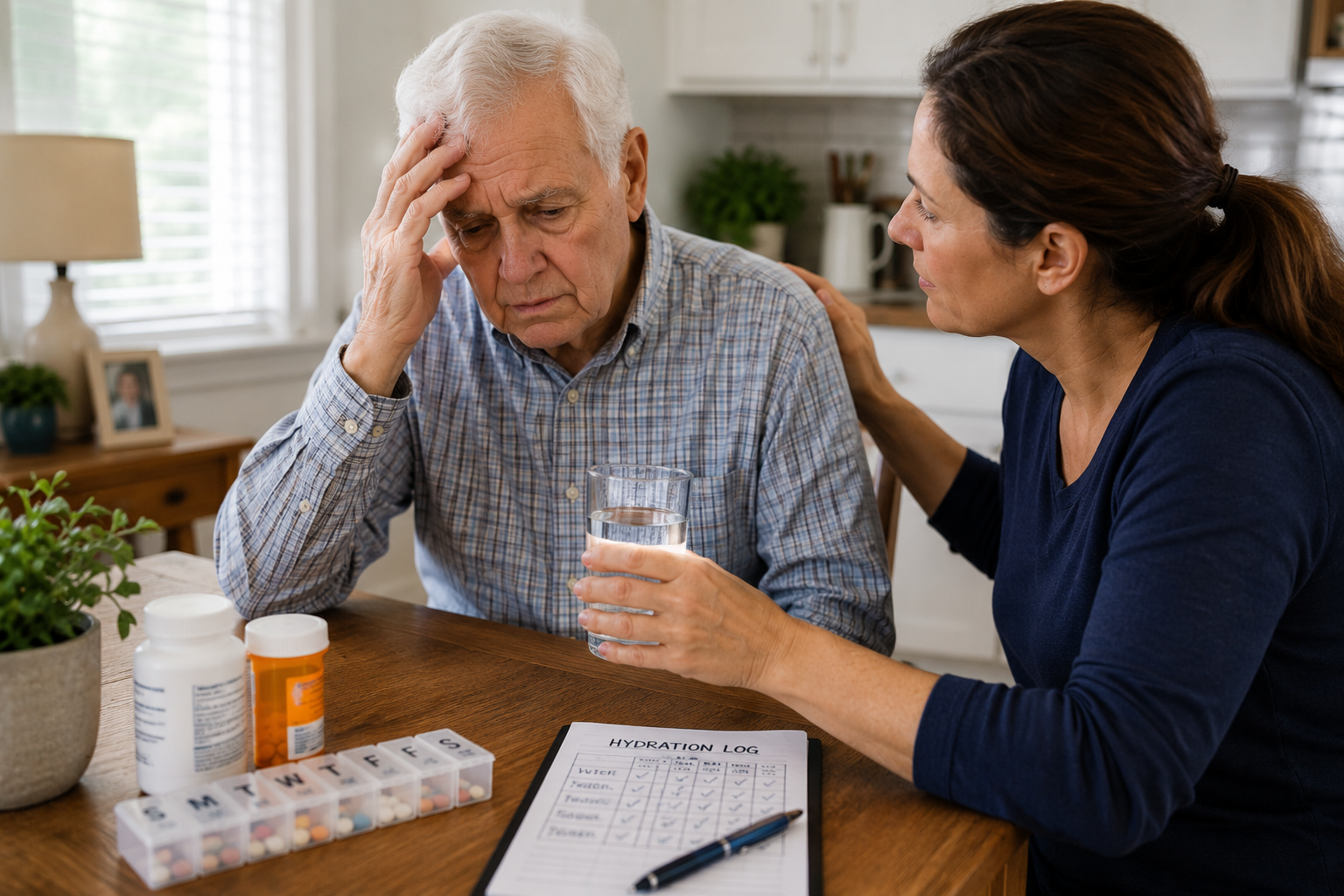
This is the second in a three-part series on dehydration in seniors. If you missed part one, it covers why older adults are prone to dehydration and the subtle signs caregivers most often overlook. This installment focuses on what dehydration is actually doing to the body while those signs are present.
Why Dehydration Is So Dangerous for Older Adults
Understanding the signs of dehydration is one thing. Understanding what dehydration is actually doing to the body while those signs are present is what drives home the urgency. In elderly patients, dehydration is rarely just “not drinking enough water.” It is a physiological cascade that can affect nearly every organ system simultaneously.
It Strains the Heart and Circulatory System: When fluid levels drop, blood volume decreases. The heart must work harder to pump thicker, more concentrated blood through the body. For a senior who already has cardiovascular disease or high blood pressure, this added strain can tip the balance toward a cardiac event. In my clinical experience, dehydration is frequently an underappreciated contributing factor in elderly patients presenting with chest pain or palpitations.
It Overwhelms the Kidneys: The kidneys depend on adequate fluid volume to filter waste products from the blood. When dehydration sets in, blood flow to the kidneys decreases and waste products begin to accumulate. In elderly patients whose kidney function is already reduced, this can escalate to acute kidney injury surprisingly quickly, sometimes within 24 to 48 hours of significant fluid loss. What begins as not drinking enough water can end in a dialysis conversation if not caught in time.
It Creates the Perfect Conditions for Urinary Tract Infections: Concentrated, infrequent urination allows bacteria to multiply in the bladder rather than being flushed out regularly. UTIs are already the most common bacterial infection in older adults, and dehydration significantly increases both the risk and the severity. As noted earlier, UTIs in seniors often present not as burning or urgency, but as sudden confusion, which brings the danger full circle.
It Dramatically Increases Fall Risk: We touched on dizziness in the previous section, but the fall risk deserves its own emphasis here. Falls are the leading cause of injury-related death in adults over 65. Dehydration contributes to falls through multiple pathways simultaneously, low blood pressure, muscle weakness, impaired balance, and cognitive confusion. A senior who is dehydrated is essentially navigating their home with multiple systems running below capacity at the same time.
It Impairs Medication Safety: Many medications that seniors rely on daily are processed and eliminated by the kidneys. When dehydration reduces kidney function, drug levels in the blood can rise to toxic concentrations even at normal doses. Blood thinners, heart medications, and diabetes drugs are particularly sensitive to this effect. A patient who has been stable on their medications for months can suddenly experience dangerous side effects simply because they have not been drinking adequately.
I recall a patient, “Mr. K,” a 78-year-old with well-controlled heart failure who was brought in after his family noticed he seemed confused and his legs were unusually swollen. His medication levels were dangerously elevated, not because his dose had changed, but because two days of reduced fluid intake had slowed his kidney clearance enough to cause toxicity. He had simply been drinking less because he felt nauseated after a minor stomach bug and nobody had connected the dots.
Nurse’s Note: Dehydration in seniors rarely announces itself loudly. It builds quietly over hours and days, and by the time the obvious symptoms appear, the body is already significantly compromised. This is why proactive hydration, offering fluids on a schedule rather than waiting for thirst, is not optional. It is a clinical imperative.
Health Risks Associated with Dehydration in Seniors
If the previous section explained what dehydration does to the body in the short term, this section is about what happens when inadequate hydration becomes a pattern rather than an isolated incident. Chronic, low-grade dehydration, the kind that never quite tips into crisis but never fully resolves either, carries its own serious set of health consequences for older adults.
Cognitive Decline and Dementia Progression: Research increasingly supports what many nurses have observed clinically for years: chronic dehydration accelerates cognitive decline in elderly patients. The brain shrinks measurably when dehydrated, and repeated episodes of even mild dehydration over time can contribute to lasting damage to memory, attention, and processing speed. For seniors already living with early dementia, inadequate hydration can worsen symptoms significantly and make it genuinely difficult to distinguish disease progression from a preventable hydration deficit.
Pressure Injuries and Skin Breakdown: Skin that is chronically under-hydrated becomes thin, fragile, and slow to heal. For seniors who spend significant time in bed or in a wheelchair, this dramatically increases the risk of pressure injuries, wounds that develop when prolonged pressure cuts off blood flow to vulnerable skin. These wounds are notoriously difficult to heal in elderly patients and can become life-threatening if they become infected. Adequate hydration is one of the most underutilized tools in pressure injury prevention.
Constipation and Digestive Complications: The digestive system relies heavily on fluid to move waste through the intestines efficiently. Chronic dehydration is one of the leading contributors to constipation in seniors, which in turn causes discomfort, reduced appetite, and in severe cases, bowel obstruction. Many elderly patients who are prescribed laxatives long-term could see significant improvement with consistent hydration alone.
Electrolyte Imbalances: Water does not travel through the body alone. It carries electrolytes, sodium, potassium, and magnesium, that regulate everything from heart rhythm to muscle contraction to nerve signaling. When fluid levels drop, electrolyte concentrations become dangerously skewed. Hyponatremia (low sodium) and hypernatremia (high sodium) are both common in dehydrated elderly patients and both carry serious risks including seizures, cardiac arrhythmias, and death in severe cases.
Increased Hospitalization and Mortality Risk: Perhaps the most sobering statistic is this: dehydration is one of the most common diagnoses among elderly patients admitted to hospital, and it is associated with significantly longer hospital stays, higher rates of complications, and increased mortality. Studies have shown that elderly patients admitted with dehydration as a primary or contributing diagnosis have markedly worse outcomes than their hydrated counterparts, even when controlling for other health conditions.
Nurse’s Note: One of the most common things I hear from families after a dehydration-related hospitalization is “I had no idea it could get that serious that fast.” Dehydration in seniors is not a minor inconvenience. It is a genuine medical emergency in the making. Treating hydration as seriously as medication adherence is not an overreaction, it is exactly the right response.
Why Dehydration Is Often Missed or Misdiagnosed
One of the most frustrating aspects of dehydration in seniors is not how dangerous it is, but how consistently it gets overlooked, by families, and sometimes even by healthcare providers. The reasons are partly physiological, partly systemic, and partly rooted in assumptions about aging that need to be gently but firmly corrected.
It Looks Like Something Else: This is the core problem. The symptoms of dehydration in elderly patients, confusion, fatigue, weakness, irritability, reduced appetite, are the same symptoms associated with dozens of other conditions common in older adults. Depression, dementia, medication side effects, infection, and simple aging are all frequently blamed for what is actually a correctable fluid deficit. Without a deliberate effort to rule out dehydration first, it is easy to reach for a more complex explanation.
The Thirst Signal Cannot Be Trusted: As discussed earlier, the thirst mechanism in elderly patients is unreliable. This creates a dangerous gap between what the body needs and what the patient reports. A senior who insists they are “not thirsty” and “drinking fine” may genuinely believe that, and genuinely be wrong. Caregivers and clinicians alike must learn not to take the absence of thirst complaints as confirmation of adequate hydration.
Skin Turgor Is Misleading in Older Adults: One of the classic bedside tests for dehydration is skin turgor, pinching the skin on the back of the hand and observing how quickly it snaps back. In young patients, slow recoil is a reliable sign of dehydration. In elderly patients, skin naturally loses elasticity with age, meaning the turgor test is far less reliable and frequently leads to an inaccurate assessment of hydration status. This is a well-documented clinical pitfall that even experienced providers can fall into.
It is Normalized as “Just Getting Older”: Perhaps the most damaging misconception is the cultural tendency to attribute almost any change in an elderly person’s behavior or energy to aging itself. Families often delay seeking help because they assume their loved one is “just slowing down” or “having a bad week.” This normalization of decline means that dehydration, and the serious conditions it triggers, goes unaddressed for far longer than it should.
Mild Dehydration Rarely Looks Dramatic: By the time an elderly patient presents with the textbook signs of severe dehydration, sunken eyes, rapid heart rate, extremely concentrated urine, the situation has already escalated significantly. The earlier, subtler stages simply do not look alarming enough to prompt action, which is precisely what makes them so dangerous.
I worked with a family whose elderly mother had been increasingly “foggy” for nearly two weeks before they brought her in. They had attributed it to grief following the loss of a close friend. In reality, she had been unconsciously reducing her fluid intake because swallowing had become slightly uncomfortable, an undiagnosed issue, and nobody had connected her cognitive changes to her hydration status. Once the swallowing difficulty was addressed and her fluids were restored, she returned to her baseline within days.
Nurse’s Note: If something feels off with your loved one, even if you cannot pinpoint exactly what, do not wait for an obvious symptom to appear. Track fluid intake for 24 hours and bring that information to their doctor. Data always tells a clearer story than a general sense that something is wrong.
About the author:
Becky Olamide is a Registered Nurse with clinical experience in PACU, pre-/post-op, and stepdown ICU, now specializing in academic writing, medical content development, curriculum design, and instructional design for healthcare and higher-education organizations. She is not an employee of B’zoe Care and does not provide care for its patients with medical services.